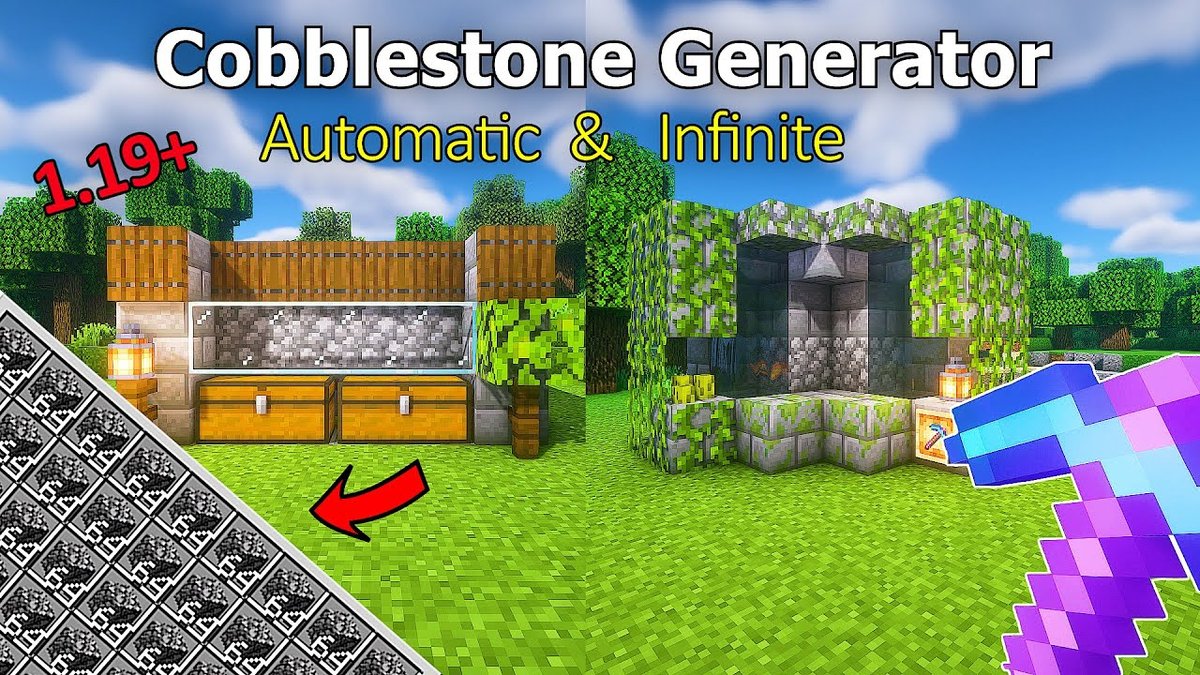
In the sprawling, blocky universe of Minecraft, space is often as precious as the rarest diamonds. Whether you're carving out a minimalist base on a Skyblock island, optimizing a sprawling mega-build, or simply trying to keep your creations tidy, efficient resource generation is key. That's where Compact and Space-Efficient Cobblestone Generator Builds come into their own, transforming cramped quarters into hubs of infinite material production without sacrificing valuable real estate.
These ingenious contraptions are more than just functional — they’re a testament to thoughtful design, allowing you to sustain ambitious projects with a renewable stream of cobblestone, the backbone of countless structures and crafting recipes, all while fitting neatly into your preferred footprint.
At a Glance: Key Takeaways for Compact Cobblestone Generators
- Core Mechanic: All generators rely on lava flowing into water (or vice-versa, with specific conditions) to create cobblestone, stone, or obsidian.
- Space is Gold: Compact designs reduce the area needed, crucial for small bases, Skyblock, or aesthetic builds.
- From Manual to Automated: Generators range from simple, hand-mined setups to complex, fully automatic factories with TNT dupers.
- Resource Efficiency: Even the most advanced designs reuse lava and water, making them highly sustainable.
- Troubleshooting: Understanding lava/water interactions is key to preventing obsidian and ensuring smooth operation.
- Scalability: Many designs can be expanded horizontally or vertically to increase output while maintaining relative compactness.
The Unseen Benefit of Smart Builds: Why Compact Cobblestone Generators Matter
Cobblestone generators are a cornerstone of Minecraft survival, providing an infinite, renewable supply of one of the game's most fundamental building blocks. But why bother with "compact" and "space-efficient"? It's not just about fitting it into a small corner; it's about optimizing your entire gameplay experience.
A well-designed compact generator saves precious land for other builds, like farms, storage systems, or aesthetic structures. It reduces the visual clutter, making your base feel more organized and intentional. For Skyblock players, where every single block of space is earned and finite, efficiency isn't just a bonus—it's survival. Even in regular survival worlds, minimizing your generator's footprint translates to less digging, fewer resources spent on its enclosure, and a generally more streamlined operation.
At its heart, a cobblestone generator works by carefully orchestrating the interaction between a source of lava and a source of water. When flowing lava touches flowing water, it creates cobblestone. Other interactions, like flowing water over still lava (obsidian) or flowing lava over still water (stone), can occur if not set up correctly. Mastering these interactions is the first step to becoming a cobblestone connoisseur.
From Humble Beginnings: The Basic Compact Generator
Every grand automated factory starts with a fundamental understanding. The simplest cobblestone generator is remarkably compact and serves as the foundation for all more advanced designs. It’s perfect for beginners, especially those just starting their journey on a Skyblock island with limited resources.
The Essential 4x1 Trench: Your First Infinite Cobble
This design is a minimalist's dream, requiring only a single bucket of water and a single bucket of lava. It produces one cobblestone block at a time, ready for manual mining.
What You'll Need:
- 1x Water Bucket (3 iron ingots)
- 1x Lava Bucket (3 iron ingots)
- A pickaxe
How to Build It (Step-by-Step):
- Dig the Trench: Find a flat area. Dig a 4-block long, 1-block wide, 1-block deep trench.
- Create the Drop: From one end of the trench, count two blocks in. Break this second block again, making it 2 blocks deep. So, you'll have a 1-block deep, then a 2-block deep, then two more 1-block deep sections.
- Place the Water: At the 1-block deep end, place your water bucket closest to the 2-block deep section. The water will flow into the deeper hole.
- Place the Lava: Go to the opposite end of the trench. Place your lava bucket on the 1-block deep section that is two blocks away from the 2-block deep hole.
- Observe the Magic: The block directly between the flowing water and the flowing lava (over the 2-block deep hole) will instantly turn into cobblestone.
Operation:
Simply mine the generated cobblestone block. A new one will appear in its place almost instantly, ready for your next swing.
Troubleshooting Tip:
If you get obsidian instead of cobblestone, it means your water is flowing over still lava, or the lava isn't flowing correctly. Double-check that the second block in your trench is indeed 2 blocks deep. This deeper hole is crucial for ensuring the water flows down and creates a point for the lava to meet flowing water. Covering the lava and water sources with non-flammable blocks (like more cobblestone or dirt) can also prevent accidental spills or items burning up.
Scaling Up Sustainably: Expanded & Hopper-Integrated Designs
While the basic 4x1 is a fantastic starting point, your building ambitions will quickly demand more. These next designs focus on increasing output and, critically, incorporating automation for hands-free collection, all while maintaining a relatively small footprint.
Producing More: The Multi-Block Cobble Row
To boost your cobblestone output, you can expand the basic design to produce multiple blocks simultaneously. This design is still quite simple but lays the groundwork for more complex setups.
Concept: Instead of just one water source and one lava source, you create rows of each, allowing them to meet and form multiple cobblestone blocks.
How to Expand:
- Widen the Water Source: Start by extending the 2-block deep water trench you used in the basic design. Make it 4 blocks long.
- Create Parallel Trenches: From the remaining 3 blocks (the shallow ones) of your original setup, extend them to create parallel 3-block long, 1-block deep trenches. This will form a roughly 4x4 square layout of shallow trenches surrounding the deeper one.
- Place Water: Place water in each block of the row directly next to your new, longer 2-block deep trench. This will ensure a broad flow of water.
- Place Lava: Place lava in each block of the row opposite your water sources.
Operation:
You'll now have a 4x1 row of cobblestone generating. You can mine along this row for significantly faster collection than a single block. While still manual, it's a step up.
Introducing Basic Automation:
To truly save effort and space, you can integrate a collection system. Dig two blocks deep underneath the entire cobblestone generation area. Create a row of hoppers directly beneath where the cobblestone generates. Connect these hoppers to a double chest (or multiple chests) placed underneath. Now, when you mine the cobblestone, it will fall into the hoppers and be funneled directly into your chests. You'll still need to do the mining, but you won't have to pick up the items!
The "Popular" Design: Compact with Auto-Collection Built-In
This design is a favorite among players for its clever use of stairs to manage water flow and its built-in automated collection system, making it incredibly space-efficient and convenient. It's a bit more resource-intensive but pays dividends in the long run.
What You'll Need:
- 2x Water Buckets
- 1x Lava Bucket
- 5x Stairs (inflammable, e.g., stone brick stairs, cobblestone stairs)
- Plenty of Solid Blocks (inflammable)
- 5x Hoppers
- 2x Chests (for a double chest)
- 1x Sign
How to Build It (Step-by-Step):
- Set Up Collection:
- Dig a 1x1 hole in the ground. Place a double chest there.
- Connect 5 hoppers. One hopper should face directly into the chest. The other four hoppers should connect to the first hopper, forming a line extending away from the chest. This creates a 5-block long hopper line.
- Enclose the Collection:
- Surround the entire hopper line and the visible part of the chest with solid, non-flammable blocks. Build this up one block high.
- Place the Stairs:
- Place 5 stairs on top of the solid blocks, directly above each hopper. Ensure the stairs are placed so they face into the generator area (like a step down), creating a trough.
- Second Layer of Blocks:
- Place another layer of solid blocks on top of the first layer of solid blocks, creating walls around your stairs. This will form a basin.
- Place the Sign:
- Stand at the end of the hopper line opposite the chest. Place a sign on the solid block directly above the end hopper. This sign will hold back the water.
- Waterlog the Stairs:
- Using your two water buckets, waterlog the stairs. Place one water source block at one end of the stair line, and the second water source block at the other end. The entire stair line should now be filled with flowing water, but it will be contained by the surrounding blocks and the sign.
- Contain the Water:
- Place a third layer of solid blocks above the stairs, extending to cover the area above the sign. This creates a fully enclosed water chamber, preventing spills.
- Introduce the Lava:
- Find the center point directly above the flowing water, one block higher than your waterlogged stairs. Place your lava bucket here.
Operation:
Stone blocks will continuously generate directly above your hoppers. Stand on the chest to mine them, and the hoppers will automatically collect the broken blocks into the chest. This design offers a compact, easy-to-use solution for generating and collecting a steady supply of stone (which you can mine with any pickaxe for cobblestone, or with a Silk Touch pickaxe for stone blocks).
Introducing Automation: Piston Power for Push-Button Cobble
Taking efficiency to the next level involves redstone and pistons. These designs automatically push generated cobblestone away from the source, allowing you to mine continuously from a single, fixed position. This significantly reduces player movement and fatigue during long mining sessions.
Keeping the Flow: Piston-Pushed Cobblestone Farms
Piston-based generators are a popular choice for their reliability and semi-automation. While you still need to mine the blocks, the system ensures a fresh block is always presented to you. For a deeper dive into the fundamental principles of how to make a cobble generator and their variations, this piston design offers a great blend of automation and control.
Core Concept: A redstone circuit powers pistons that push newly generated cobblestone blocks along a line. When the first block is pushed, a new one generates in its place, and the cycle continues.
What You'll Need (for one module):
- 2x Water Buckets
- 1x Lava Bucket
- 8x Pistons
- 2x Redstone Torches
- 1x Redstone Repeater
- 11x Redstone Dust
- 5x Stairs (inflammable)
- Solid Blocks (inflammable)
- 1x Lever
Basic Setup Principles:
- Cobblestone Generation Area: Construct a water source similar to the "Popular Design" using waterlogged stairs surrounded by solid blocks. The lava source will sit one block above this, positioned to create cobblestone directly in front of the piston.
- Piston Line: Place a line of 8 pistons horizontally, one after another, positioned to push the generated cobblestone. The first piston will be directly behind where the cobblestone forms.
- Redstone Circuitry:
- Build a compact redstone clock or a simple repeater delay system. A common setup involves two redstone torches creating an inverted signal, connected to a repeater, which then powers the redstone dust leading to the pistons.
- Place a lever to easily turn the entire piston system on or off.
How it Works:
Once activated by the lever, the redstone circuit will continuously power the pistons. As a cobblestone block generates, the first piston pushes it. This push cascades down the line, moving all previously generated blocks one step forward. You can then stand at the end of the line and mine the freshly pushed blocks.
Pros & Cons: - Pros: Highly reliable, allows for continuous mining from a fixed point, prevents lava from spreading or blocks from falling into inaccessible areas.
- Cons: Can be slow if you're only generating one block at a time, and the push limit of 12 blocks per piston means you'll eventually need to turn it off and mine the entire line. It’s also more resource-intensive due to the redstone components.
The Pinnacle of Efficiency: Fully Automated, High-Output Cobblestone Factories
For the truly ambitious, or those with massive resource demands, the ultimate compact and space-efficient cobblestone generator is a fully automated system leveraging TNT duplication for automatic breaking and sophisticated collection. These are complex redstone builds, often referred to as "cobblestone farms" or "factories."
Deconstructing the Masterpiece: TNT Duper Cobble Generators
This advanced design is a marvel of Minecraft engineering, capable of producing thousands of cobblestone blocks per hour without any player interaction after initial setup. It's not for the faint of heart, but the payoff is immense.
What You'll Need (Extensive):
- Water & Lava Buckets
- ~40 Leaves (or other non-flammable, non-full blocks like glass panes)
- 7x Sticky Pistons
- 5x Regular Pistons
- 5x Target Blocks (or other full solid blocks for redstone)
- 2x Observers
- 1x Block of Redstone
- 2x Redstone Comparators
- 3x Redstone Repeaters
- 6x Slime Blocks
- 1x TNT
- 1x Fence
- 1x Dead Coral Fan (Crucial for TNT duper)
- 1x Detector Rail
- 1x Minecart
- 3x Fence Gates
- Plenty of Redstone Dust
- Solid Blocks (inflammable, e.g., stone, obsidian)
- ~1.5 stacks Obsidian (for blast resistance)
- 2x Levers
- 2x Slabs
- Chests & Hoppers (at least 3)
- 1x Stair
This build integrates several sophisticated redstone mechanisms:
The Generator Core: Water, Lava, and Observers
- Water Source: Create a contained water source using waterlogged leaves or slabs. This provides the 'still water' element for the cobblestone.
- Lava Ring: Position a lava source (often a ring of lava surrounding a central point) such that its flowing lava interacts with the still water, generating cobblestone in a specific spot.
- Observers: Place observers to detect when a new cobblestone block appears. These observers then send a redstone signal.
- Piston System: The observer signal triggers sticky pistons to pull the newly generated block downwards, followed by regular pistons that push the block into a specific path towards the TNT explosion zone. This ensures blocks are continuously generated and moved.
The Blasting Heart: The TNT Duper in Detail
This is the key to automatic breaking. A TNT duper is an exploit-based mechanism that continuously creates and drops TNT without consuming the original TNT block.
- Frame: Construct a sturdy, blast-resistant frame, often using obsidian, 12 blocks away from the generator to prevent damage.
- Slime Blocks & Pistons: A core part of the duper involves sticky pistons pushing slime blocks, which in turn push the TNT, detector rail, and minecart.
- Coral Fan: A crucial component is a dead coral fan, which serves as a non-solid block that can be pushed into the TNT, causing it to prime without detonating the original TNT block.
- Activation: When activated by a redstone pulse, the sticky pistons move the slime block system, which "dupes" the TNT, causing a new primed TNT block to appear and fall.
Precision Timing: The Etho Hopper Clock
To control the rate at which TNT is duplicated (and thus cobblestone is broken), an Etho Hopper Clock is typically used.
- Hoppers & Comparators: This clock consists of two hoppers facing into each other, with redstone comparators reading their contents.
- Sticky Pistons & Redstone Block: The comparators trigger sticky pistons that move a redstone block, which then powers the TNT duper's activation circuit.
- Timing: The clock's speed is determined by the number of items placed in one of the hoppers (e.g., 4 items for a common timing). It creates a consistent, slow pulse to prevent overloading the system or breaking too many blocks at once.
Seamless Cleanup: The Collection System
After the TNT blasts the cobblestone, you need to collect it efficiently.
- Blast Chamber: Beneath the TNT explosion area, create an 11x11 obsidian platform with 2-block tall walls. This contains the blast and prevents item despawns.
- Water Flow: Set up a water flow system within this chamber (often using strategically placed water source blocks) to channel all the broken cobblestone blocks to a central point.
- Hoppers & Chests: At the collection point, a series of hoppers funnel the items into multiple chests for massive storage.
- Access Stair: Place a stair block above the collection chest. This allows you to open the chest while preventing items from flowing past into unwanted areas.
Operation:
Once activated with a lever, the generator core produces cobblestone, which is detected by observers and pushed by pistons. Simultaneously, the Etho hopper clock periodically activates the TNT duper, which creates and drops primed TNT. This TNT explodes, instantly breaking the accumulated cobblestone. The water flow system then guides all the shattered blocks into your hopper-chest storage system.
Maintenance and Pitfalls:
- Push Limit: Always deactivate the generator with a lever before the regular pistons reach their push limit (12 blocks). If they push past this, they can break and potentially delete lava sources, causing the generator to malfunction.
- Lava Deletion: While rare in well-designed systems, lava can occasionally be deleted by pistons if components are misaligned. Have a backup lava bucket ready.
- Explosion Damage: Ensure all critical components are blast-proof (obsidian) or far enough away from the TNT explosions.
Choosing Your Perfect Cobble Companion: Decision Factors
With such a range of designs, how do you pick the right compact cobblestone generator for your world? Consider these factors:
- Resource Availability: Early game in Skyblock? Stick to the basic 4x1. Later on with abundant iron and redstone? Explore automated options.
- Desired Output Rate: Need a few stacks for a small house, or thousands for a perimeter? Your ambition dictates the complexity.
- Technical Skill Level: Are you comfortable with basic redstone? Or do you prefer simple manual designs? Start simple and build up your skills.
- World Type: Skyblock players often prioritize the most compact and material-efficient builds due to extreme resource limitations. In a regular survival world, you might have more flexibility.
- Space Constraints: Do you have a tiny corner, or a reasonable plot? Even the "expanded" designs can be quite compact when integrated into a wall or floor.
Common Cobblestone Generator Conundrums: Quick Fixes & Insights
Even seasoned players encounter issues. Here are some common problems and their solutions:
"Why am I getting obsidian instead of cobblestone?"
This is almost always due to flowing water touching still lava. Ensure your lava is flowing (e.g., placed on a block above the interaction point) and your water flow is correctly creating the point where they meet. The basic 4x1 design's 2-block deep hole is critical for this.
"My hoppers aren't collecting the blocks."
Check that your hoppers are correctly pointing into the chests or into another hopper leading to the chests. Hoppers collect items from the block directly above them. If the items are landing on a solid block next to a hopper, they won't be picked up.
"How do I prevent lava from disappearing?"
Lava sources can be deleted if pistons push blocks through them, or if they are exposed to water in unintended ways. Always enclose your lava source blocks with non-flammable, solid blocks. In advanced piston designs, be mindful of the 12-block piston push limit to prevent malfunctions that could delete lava.
"Stone vs. Cobblestone: What's the difference in generators?"
Some generators (like the "Popular Design" with stairs) produce stone blocks directly. If you mine these with a regular pickaxe, they will drop cobblestone. If you use a pickaxe enchanted with Silk Touch, they will drop stone blocks. If you use Fortune, they will drop more cobblestone. Cobblestone generators always produce cobblestone directly. Both are useful, but if you specifically need stone blocks without an extra step, a "stone generator" (creating stone via flowing lava on still water) mined with Silk Touch is your answer.
Beyond the Build: Maximizing Your Cobblestone Yield
Building a great generator is just the first step. To truly get the most out of your compact creation, consider these additions:
- Pickaxe Enchantments: For manual or semi-automated mining, invest in a pickaxe with Efficiency (for faster breaking), Fortune (for more drops per block), Unbreaking (for durability), and Mending (to repair with XP).
- Storage Solutions: If you're building a high-output factory, you'll need a robust storage system. Connect your collection hoppers to rows of chests, or even a more advanced item sorter system.
- Integrating into Larger Bases: Think about how your generator fits into your overall base design. Can you disguise it, build it into a wall, or incorporate it into a dedicated resource production zone? Its compact nature makes this much easier.
Your Next Block-Breaking Adventure Starts Here
From the humble beginnings of a 4x1 trench to the awe-inspiring complexity of a TNT-duping factory, compact and space-efficient cobblestone generator builds are essential for any serious Minecraft player. They empower you to overcome resource limitations, streamline your workflow, and free up precious space for all your other creative endeavors.
Whether you're looking for a simple, reliable source or aiming for ultimate automation, there's a design perfectly suited to your needs. Take these insights, fire up your world, and start building the cobblestone factory of your dreams – because in Minecraft, every block counts, and smart design makes all the difference.